Client Name
Neki
Service Offered
Research & UI UX Design
Domain
Philanthropy
Project overview(s)
Project 1: Understanding the space between intention and action
NEKI.IO began with a behavioural question rather than a product brief. Companies wanted to contribute. Non-profits were doing meaningful work. Yet the systems connecting them felt fragmented and administrative. The intent was human. The infrastructure was not.
We studied how corporate teams approach social responsibility, how employees decide to volunteer, and how non-profits sustain trust over time. Interviews, stakeholder mapping, and competitive analysis revealed a recurring pattern: participation was often shaped by obligation, visibility, or convenience rather than long-term alignment. Discovery felt inconsistent. Trust signals were unclear. Opportunities lacked context.
The insight was simple but foundational. The challenge was not access, but alignment. Before designing screens, we defined how information should flow, how organisations should present themselves, and how individuals evaluate where to contribute. Strategy focused on creating continuity rather than transactions.
Project 2: Designing the experience for continuity
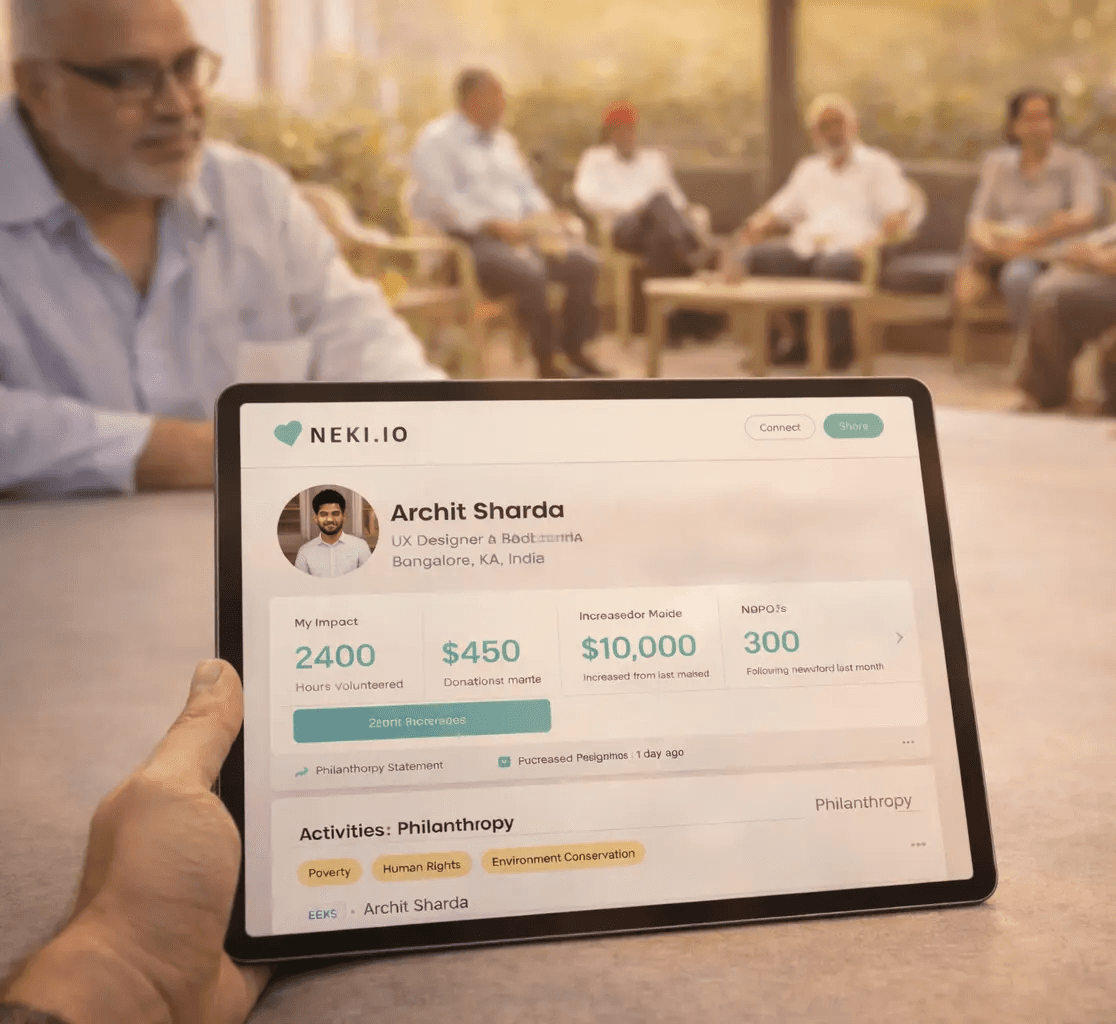
With structure defined, the platform experience was shaped around relational journeys rather than marketplace patterns. User flows were redesigned to reduce administrative friction and clarify intent. Onboarding, profile creation, and opportunity discovery were simplified to support different actors, corporate admins, non-profit coordinators, and individuals, without overwhelming them.
The interface prioritised composure. Clear hierarchy, restrained interaction patterns, and consistent navigation logic created a sense of steadiness across the product. Instead of competing for attention, the experience aimed to support meaningful participation.
Project 3: A design system for trust and consistency
As the product direction evolved, so did the visual language. The design system was developed to ensure consistency across web experiences while reinforcing trust and warmth.
Color choices were guided by calmness and optimism. Typography and spacing were treated as structural tools rather than decorative elements. A reusable component library ensured scalability while maintaining coherence across states, modules, and user roles.
The result was not a loud social platform, but a considered environment for sustained engagement. NEKI.IO shifted from a listing space for opportunities to a structured system that supports long-term participation and continuity.